
TPMS (Tire Pressure Monitoring System) became mandatory on new M1-category vehicles in the European Union from November 2014, under Regulation No. 661/2009. This requirement applies to vehicles when they are placed on the market; it does not mean older vehicles must be retrofitted. This distinction is central to understanding what the law allows, what it prohibits, and where ambiguity is being wrongly exploited.
TPMS sensor diagnosis: distinguishing hardware failure from communication faults
A persistent TPMS warning light does not always mean that tire pressure is incorrect. In a significant proportion of cases, the problem is caused by a sensor or radio communication fault between the wheel sensor and the vehicle’s control unit. The internal battery may be nearing the end of its life, the sensor may have been damaged while removing a tire, the valve may be corroded, or the sensor protocol may simply no longer be recognized after a wheel replacement.
This initial diagnosis determines what happens next. Before considering disabling your car’s TPMS, you need to identify the specific wheel and component at fault. An OBD diagnostic tool or a dedicated TPMS reader (such as Autel or ATEQ) can read each sensor’s ID, check its radio response, and isolate the fault.
On a vehicle more than ten years old, the internal battery in direct TPMS sensors is often the main culprit. These batteries cannot be replaced, so the entire sensor must be changed. This is when cost becomes a factor in the decision.
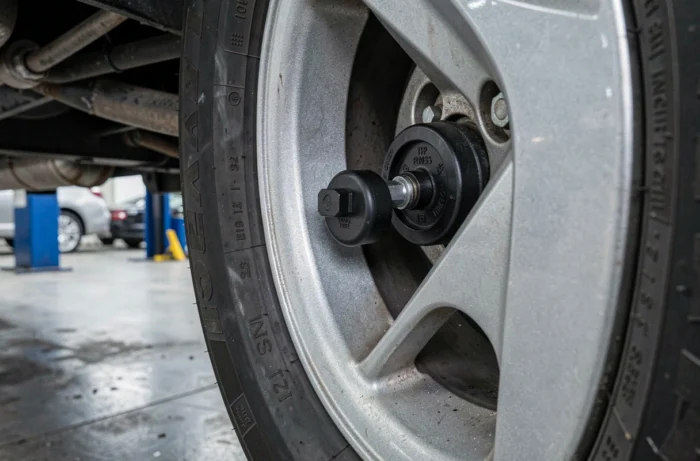
TPMS replacement cost versus disabling the system: the real calculation
An original-equipment direct TPMS sensor costs anywhere from a few dozen euros to over a hundred, depending on the make and model. Multiply that by four wheels, then add the labor for removing and refitting the tires and reprogramming the control unit, and the bill can quickly mount up—sometimes exceeding the value of the vehicle itself.
Programmable universal sensors (Alligator, Schrader EZ-sensor, HUF IntelliSens) offer a less expensive alternative. However, they require a cloning tool to copy the original sensor ID or a vehicle-specific relearn procedure.
Faced with these costs, some owners of older or modified vehicles consider disabling the system. There are two very different situations to distinguish here:
- A vehicle registered before November 2014 and not originally equipped with TPMS: there is no requirement to install one. There is no warning light, so the issue does not arise.
- A vehicle originally equipped with direct or indirect TPMS whose system has failed: disabling it means removing approved safety equipment, with consequences for the roadworthiness test and in the event of an accident.
- A modified vehicle (with different wheels, performance modifications, or a conversion) whose original sensors are no longer compatible with the new wheels: replacing them with suitable sensors remains the only compliant option.
Roadworthiness test and disabled TPMS: defect classifications
A non-functioning TPMS on a vehicle originally equipped with one is a roadworthiness test inspection item. The decree of October 23, 2023, concerning roadworthiness tests distinguishes between two levels of penalty, depending on the severity of the defect found.
A major defect results in an unfavorable test outcome, with a retest required within two months. A critical defect limits the test’s validity to that same day. Available sources do not allow us to say with certainty which category a disabled TPMS will always fall into: this depends on the inspector’s assessment and the type of malfunction found (warning light permanently on, no signal, or the system physically disconnected).
In practice, a TPMS warning light illuminated on the dashboard during the test will be noted. Hiding the warning light by modifying the control unit does not fix the defect; it simply makes it invisible until the next in-depth diagnostic check.
Insurance implications not to overlook
Beyond the roadworthiness test, disabling an approved safety system may be cited by an insurer in the event of an accident involving underinflated tires. If a post-accident inspection reveals that the TPMS was deliberately disabled, coverage for the claim may be disputed.
Indirect TPMS: an often-overlooked alternative on older vehicles
Vehicles equipped with indirect TPMS do not use physical sensors in the wheels. Instead, the system uses data from the ABS sensors to detect a change in rolling diameter, which can indicate underinflation. There is no battery to replace, no special valve, and no sensor to program.
When the warning light comes on in an indirect system, resetting it is usually all that is needed. This can be done through the onboard computer menu or with a dedicated button, after correcting the actual pressure in all four tires. If the warning light stays on after the reset, the fault is most often with an ABS sensor, not the TPMS itself.
We find that confusion between direct and indirect TPMS accounts for some requests to disable the system. With an indirect system, talking about “disabling” it does not really make technical sense: all you need to do is reset it correctly.

TPMS regulations and commercial vehicles: expansion in 2024
The regulations no longer apply only to passenger cars. UNECE Regulation No. 141 extends the TPMS requirement to various categories of commercial vehicles newly registered from July 2024. New light commercial vehicles and heavy goods vehicles are gradually being brought within scope.
For fleet managers, this changes the picture. A used commercial vehicle purchased without TPMS is not subject to a retroactive requirement, but a new vehicle registered after July 2024 is. Managing a mixed fleet of older and newer vehicles therefore requires knowing the exact status of each vehicle.
Disabling a TPMS on a vehicle originally equipped with one is a false economy. The cost of a compliant replacement, even on an older vehicle, helps avoid a failed roadworthiness test and an insurance dispute. With an indirect system, a simple reset resolves most cases. The right question is not how to disable the system, but why the warning light is on and which specific component is at fault.