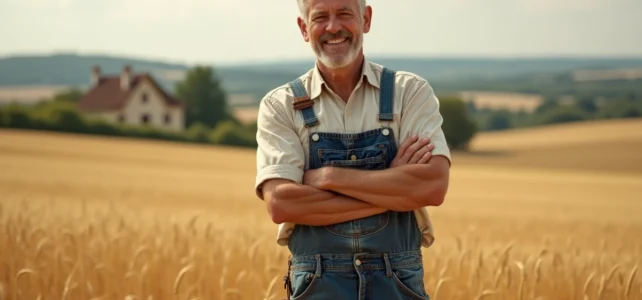
The richest farmer in France does not exist in the form of an official ranking. French agricultural wealth is based on a logic of professional and land heritage, not on a salary income comparable to that of a CAC 40 executive. Understanding this mechanism changes the interpretation of any “success story” in the sector.
Agricultural Land Heritage: The True Measure of Wealth in Farming
Insee’s research confirms this: for farmers, wealth is primarily linked to the ownership of professional and land assets. A cereal farmer in Beauce who owns several hundred hectares can show a gross wealth greater than that of some industrial company leaders, while declaring a modest annual income after depreciation and expenses.
This distinction between wealth and income explains why no farmer appears in the Challenges ranking of the 500 richest fortunes in France. The fortunes that appear in the agri-food sector (Mulliez, Holder, Leclerc families) are related to processing and distribution, not agricultural production. To delve deeper into the journey of a wealthy farmer on Club Entrepreneur, one must read between the lines of this frequent confusion between farmer and industrialist.
We observe that farms of over 100 hectares control a very large share of the French agricultural usable area. Land concentration mechanically produces impressive balance sheets, but land remains a relatively illiquid asset. Selling a large crop farm takes months, sometimes years, which puts the notion of “wealth” in the usual sense into perspective.

Agricultural Income in Île-de-France: The Territorial Anomaly
Insee, as reported by Le Parisien in February 2025, highlighted a rarely discussed fact in general articles: agricultural households in Île-de-France show an average annual income higher than that of the rest of metropolitan France. The proximity to Paris, the size of cereal farms in the Saclay plateau or Brie, and access to specific value-added circuits explain this gap.
This territorial differential illustrates a technical point that the profession knows well. The profitability of a farm depends less on individual talent than on three structural factors:
- The geographical location and type of soil, which determine gross yields and land pressure when purchasing
- The size of the farm, with an economic viability threshold that has been rising for two decades
- Access to CAP aids, the distribution of which remains very unequal (a minority of farmers capture a disproportionate share of direct aids)
An organic vegetable grower in a peri-urban area and a cereal farmer with 300 hectares in Picardy do not operate in the same economic universe. Comparing their incomes without mentioning these structural parameters is akin to comparing a craft baker and an industrial franchisee.
Diversification and Sales Channels: What Distinguishes the Most Profitable Farms
Diversification is not a marketing concept. It is an economic survival lever for medium-sized farms that cannot rely on volume. Farms that combine production, processing, and direct sales capture a margin that the traditional farmer relinquishes to intermediaries.
Direct sales and on-farm processing can multiply the added value by two or three compared to sales through cooperatives. A farmer who sells his meat packages through short circuits retains a margin that is entirely absorbed by going through a slaughterhouse-wholesaler.
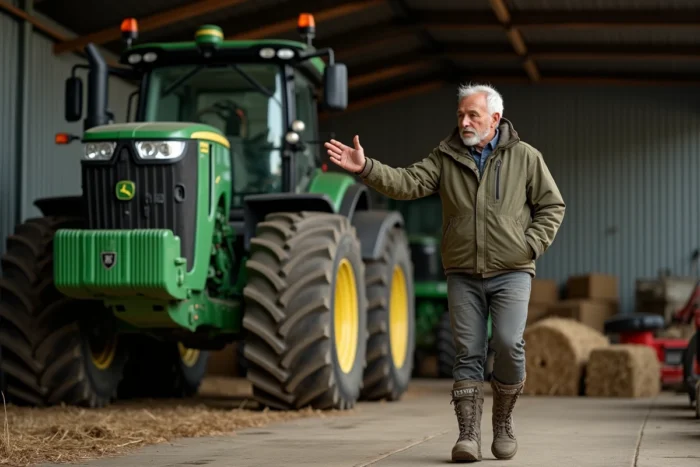
Some farmers go further. Wine diversification, for example, combines vineyards with other activities (horse breeding, tourism) to smooth income against price volatility. Initiatives like the brand “C’est qui le patron?!” have also allowed dairy producers to secure a floor price, although the model remains limited in volume.
CAP Aids and Tax Optimization of Farms
The most capitalized farmers do not just produce. They structure their activity in corporate form (EARL, GAEC, SCEA), which allows for tax optimization and facilitates transmission. The legal form of the farm conditions both net wealth and the choice of crops.
Using precautionary savings (deduction for precautionary savings, ex-DPA/DPI) and careful management of depreciation allows for smoothing taxable results over several years. A farmer who generates a high gross surplus in one year can neutralize a large part of it for tax purposes, making the reading of declared incomes particularly misleading.
Transmission and Land Accumulation: The True Driver of Agricultural Wealth
The question of agricultural wealth is not limited to an individual journey. Land accumulation over several generations remains the primary factor of enrichment in the sector. A farmer who inherits land free of lease holds a structural advantage that neither talent nor innovation can compensate for alone.
The pressure on agricultural land has increased in recent years. Recent analyses highlight that non-agricultural actors (investors, energy groups, pension funds) are entering the land market, driving up prices and making non-family installations increasingly difficult.
- The average price of agricultural land has steadily increased, with considerable disparities depending on regions and types of crops
- Non-family installations represent a growing share of new farms, but these farmers start with a major heritage handicap
- Family transmission remains the main channel for accessing land, perpetuating starting inequalities among farmers
The “richest” farmer in France is likely a cereal farmer from Île-de-France whose family has owned the land for several generations, who has managed to structure his farm as a company and optimize his tax flows. This profile is far from an individual success story in the media sense. It reflects a system where land, location, and transmission matter more than personal journey.