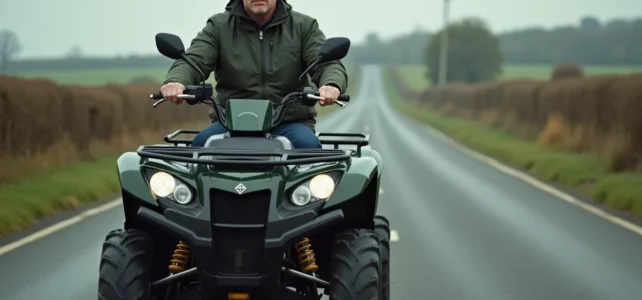
Choosing a road-legal adult quad with a B license requires comparing regulatory categories, power thresholds, and practical uses that do not always overlap. Between a heavy quadricycle limited to 90 km/h and a utility model restricted to 60 km/h, the differences in price, maximum speed, and circulation rights can vary widely. This article measures these differences to guide a purchase in 2024.
L6e or L7e Homologation: Table of Regulatory Differences
The distinction between L6e and L7e categories determines the maximum speed, allowed power, and accessible roads. Confusing the two means buying a vehicle that does not match either one’s license or travel needs.
| Criteria | L6e (light quadricycle) | L7e (heavy quadricycle) |
|---|---|---|
| Max engine capacity | 50 cm3 | Above 50 cm3 |
| Max power | 4 kW | 15 kW |
| Max speed | 45 km/h | 90 km/h |
| Required license | AM (from 14 years) or any higher license | B1 or B |
| Highway access | No | No (insufficient power) |
An L7e quad, even if road-legal, remains prohibited on highways. Quadricycles with power not exceeding 15 kW are excluded from fast lanes, as they cannot maintain the minimum expected speed of 80 km/h without creating a hazard. This point, rarely mentioned in product sheets, automatically rules out highways for nearly all road-legal quads.
Identifying the best road-legal adult quad with a B license therefore starts with choosing the L7e category, the only one compatible with regular road use beyond 45 km/h.
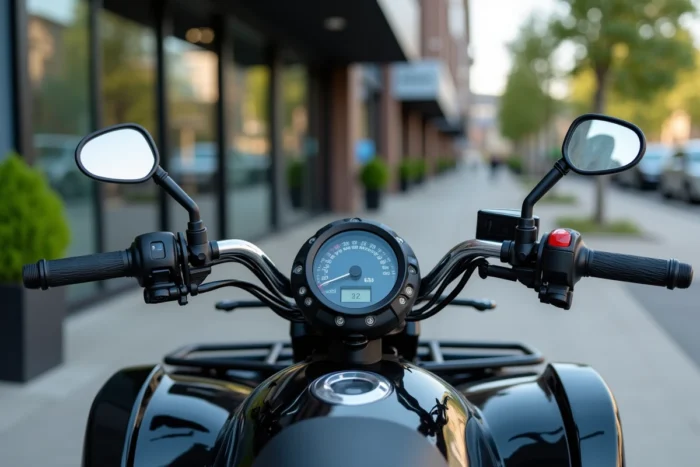
Road-Legal Quad and B License: How Power Affects Daily Use
The limit of 15 kW (approximately 20 HP) imposed on heavy quadricycles has direct consequences on hill performance, overtaking, and speed maintenance on national roads. A quad close to this limit offers sufficient acceleration to merge into traffic. A model restricted well below this limit can make certain situations uncomfortable, even risky.
Manual or Automatic (CVT) Transmission
The majority of road-legal quads in the utility category adopt a CVT transmission. Gear shifting is seamless, simplifying driving on open roads. In contrast, a quad with a manual gearbox provides finer engine control on varied terrain.
For primarily road use (commuting, connections between agricultural plots), the CVT reduces fatigue and limits handling errors. For mixed use on roads and paths, the manual gearbox remains relevant if the driver is accustomed to two-wheelers.
Actual Speed vs. Homologated Speed
The speed indicated on the registration document (often 90 km/h for an L7e) does not always correspond to a comfortable cruising speed. A quad whose engine runs at full throttle at 85 km/h will be noisy, consume more fuel, and wear out faster than a model reaching this speed at mid-rev. Checking the engine’s torque curve, when available, provides a more reliable indication than just the maximum speed stated.
Models of Road-Legal Adult Quads: Comparison by Use
Three usage profiles emerge for a road-legal quad with a B license. The table below cross-references these profiles with available references on the French market in 2024.
| Main Use | Brand / Range | Transmission | Strength |
|---|---|---|---|
| Utility / Agricultural | Hytrack HY 200 ST (T3) | CVT | Accessible entry price, T3 homologation |
| Leisure / Versatile | Kymco MXU 300i | CVT | Proven reliability, dealer network |
| Sport / Road-Legal Off-Road | CFMOTO CForce 520 | CVT | Towing capacity, short turning radius |
T3 homologation (agricultural vehicle, speed limited to 60 km/h) concerns quads intended for work in farming. It differs from L7e homologation and restricts circulation to departmental and municipal roads. A buyer planning trips on national roads must ensure that the quad has L7e homologation and not T3.
Insurance and Maintenance of a Homologated Quad: Often Underestimated Costs
Insurance for a road-legal quad is mandatory, just like for a car. Rates vary based on power, category, and declared use. A utility T3 quad generally costs less to insure than a leisure L7e, but the coverage is also more limited (no coverage on fast lanes, for example).
- Ensure that the contract covers circulation on open roads and not just private paths, as some “quad” policies exclude public road networks.
- Budget for regular maintenance: oil changes, filters, brake pads, chain or CVT belt tension. A quad used on the road wears differently than an off-road quad, with more consistent demand on the transmission and tires.
- Check the condition of road-legal tires (marked “E”): off-road tires that are not homologated make the quad non-compliant during inspections.
Registration and Plates: Specific Procedures for Quads
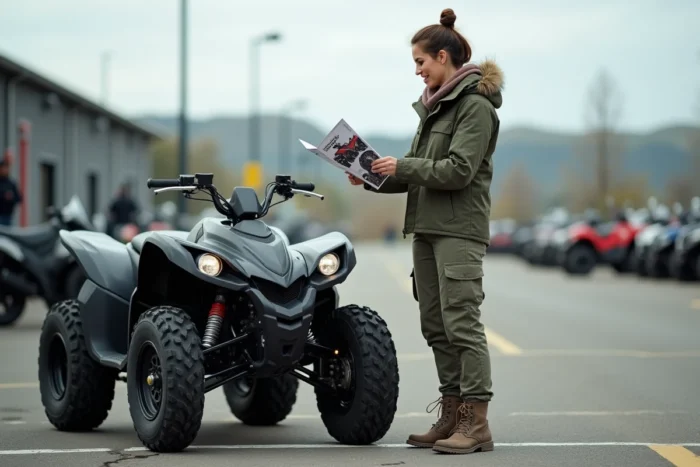
Every road-legal quad must be registered and display a plate that complies with the regulatory format. The request is made through the Vehicle Registration System, just like for a regular vehicle. The European Certificate of Conformity (COC) provided by the manufacturer or importer is essential to obtain the registration document.
Without a COC, registration becomes a lengthy and costly isolated reception procedure with the DREAL. Buying a quad without a COC exposes one to administrative blockage that can last several months. This document must be included in the list of documents provided at the time of sale.
The choice of a road-legal adult quad with a B license relies less on raw power than on the coherence between homologation category, actual use, and associated circulation rights. A versatile L7e with CVT transmission covers most road needs, provided that the certificate of conformity, insurance, and tires are aligned with public road use.