
The anti-theft system of the Peugeot Boxer relies on a dialogue between the transponder chip housed in the key and the engine control unit. When this dialogue fails, the engine refuses to start, even if the starter turns normally. Understanding this electronic mechanism allows one to distinguish a genuine anti-theft failure from a simple battery or wiring issue, and to avoid costly intervention on a system that is functioning correctly.
Transponder, BSI, and SID208 ECU: the communication chain of the Boxer
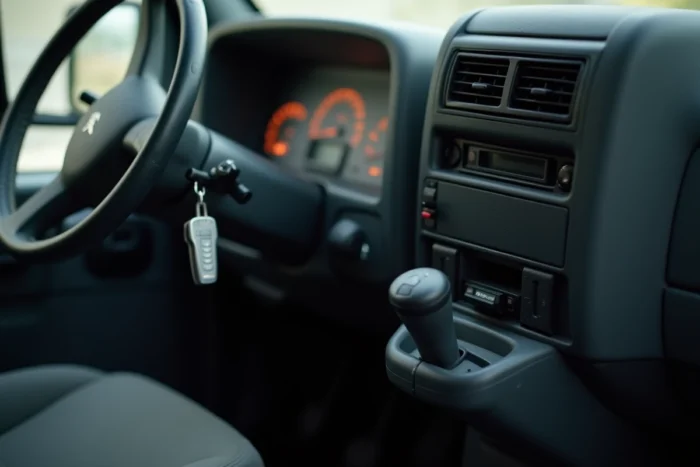
The anti-theft system of the Peugeot Boxer involves three components that must mutually authenticate each time the ignition is turned on. The transponder chip embedded in the key emits a unique code captured by the antenna around the ignition lock. This code is transmitted to the BSI (intelligent service box), which compares it to its database.
If the code matches, the BSI allows the engine control unit to enable fuel injection and ignition. On Euro 5 and Euro 6 Boxers, the ECU used is the SID208, directly paired with the anti-theft system. Any break in this chain of three links causes a blockage.
A technical point that Boxer owners often overlook: when a SID208 ECU is delivered as a spare part with a so-called “VIRGIN” configuration, it does not disable the anti-theft system. This preparation only allows a clean initial pairing with the BSI and the key during installation. The immobilizer function remains active. Confusing “VIRGIN” with “IMMO OFF” is a common mistake that leads to unnecessary purchases.
For those wishing to disable the anti-theft system on Peugeot Boxer, this distinction between the two procedures is the first point to master before taking any action.
Peugeot Boxer anti-theft failure: diagnosis before any deactivation
Before considering reprogramming or removing the immobilizer, a methodical diagnosis is essential. A significant proportion of failures attributed to the anti-theft system are not actually caused by it.
Common causes that simulate an immobilizer blockage
- A battery voltage that is too low prevents the BSI from reading the transponder correctly. The anti-theft light comes on, but the system is not at fault. A simple check with a voltmeter (above 12.4 V with the engine off) can rule out this possibility.
- A problem with the electrical wiring between the ignition lock antenna and the BSI interrupts communication without the chip or ECU being faulty. In a utility vehicle like the Boxer, subjected to vibrations and intensive use, connectors degrade faster than in a sedan.
- A key with a damaged or desynchronized transponder chip. Testing with the second original key allows for isolating the problem in a matter of seconds.
Field reports on vehicles with transponders confirm that this “diagnose first” approach avoids heavy interventions. On comparable models, a poorly connected wiring harness or a weak battery exactly reproduces the symptoms of an immobilizer failure.
IMMO OFF reprogramming on Peugeot Boxer: what the service entails
When the diagnosis confirms a real malfunction of the anti-theft system (faulty BSI, irreparable pairing loss, incompatible replacement ECU), the so-called IMMO OFF service comes into play. It involves removing the anti-theft function at the level of the engine control unit itself.
Reprogramming specialists now clearly distinguish in their catalog for Boxer and Jumper the services “VIRGIN” and “IMMO OFF”. The latter removes the transponder code verification: the engine starts without key authentication. The vehicle remains functional but loses its electronic theft protection.
Concrete consequences of an IMMO OFF removal
The complete deactivation of the immobilizer has repercussions beyond the mechanics. The vehicle’s insurer considers the anti-theft system as original safety equipment. Removing this function can invalidate theft coverage if the insurer is not informed. Checking the contract clauses before the operation avoids an unpleasant surprise in case of a claim.
From a technical standpoint, IMMO OFF reprogramming does not alter the engine mapping or injection parameters. The SID208 ECU retains all its engine management functions. Only the transponder verification module is disabled in the software.

Spare key and BSI re-pairing: alternatives to deactivation on Boxer
Removing the anti-theft system remains a last resort solution. Two alternatives deserve exploration before reaching that point.
The first involves having a new key with a virgin transponder programmed by a professional equipped with Peugeot diagnostic tools (or a compatible multi-brand tool). The BSI of the Boxer can register multiple keys. If the unit is not faulty, adding a correctly coded key restores starting without touching the ECU.
The second involves a complete BSI-ECU re-pairing. This operation requires a visit to a dealership or an automotive electronics specialist with the manufacturer’s software. It restores communication between the three components without removing the anti-theft protection.
The choice between re-pairing and IMMO OFF depends on the condition of the BSI. A service box with corrupted memory sometimes makes re-pairing impossible, and reprogramming the ECU then becomes the only option to get the Boxer back in service.
Regardless of the method chosen, keeping the second original key in a safe place remains the best insurance against future blockage. In a professional utility vehicle, prolonged immobilization incurs a direct cost that far exceeds that of a pre-programmed duplicate key.