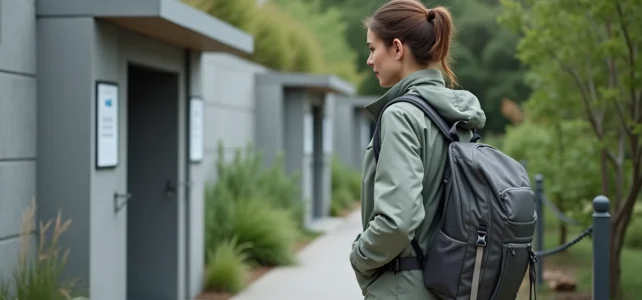
Free public showers are not found by chance. Community databases have their limits, and results vary greatly depending on whether you are in coastal, urban, or rural areas. Here, we detail the most reliable methods to locate an accessible water point, distinguishing official sources from grassroots solutions.
Municipal open data: the underutilized lever for locating a free shower
Articles on the subject consistently direct readers to community applications. We recommend starting with another channel: interactive maps published by local authorities. In recent years, several major cities have put online open databases listing public restrooms, fountains, water points, and, in some cases, showers attached to sports facilities or urban beaches.
Luxembourg City, for example, integrates public restrooms and water fountains on the same interactive map, allowing users to identify areas where a quick rinse is possible in public spaces.
These sources are maintained by municipal services, making them more up-to-date than a three-year-old user review. They also cover facilities that mainstream applications do not index, such as showers at nautical bases or municipal stadiums open to the public at certain hours.
Before launching a search on an app, type the name of the city followed by “open data restrooms” or “interactive toilet map” into a search engine. The result is often more accurate than any community filter.
Additionally, the website toilettespubliques.com is now the main free platform for locating restrooms in France, covering both mainland and overseas territories. It does not only list toilets: some points correspond to municipal facilities that have showers. Cross-referencing this database with a city’s open data allows for reliable coverage when you are looking to find a free public shower nearby without relying on a single tool.
Beach showers, municipal pools, and leisure centers: real access criteria
Outdoor beach showers are often cited as an obvious solution. In practice, their availability depends on three factors that guides often overlook.
- Seasonality: most beach showers only operate during the official bathing season, usually from June to September. Off-season, the taps are turned off or the facilities dismantled.
- The type of rinse: many beach showers only provide a limited cold water spray (push-button with a timer). Washing with soap is prohibited in most coastal municipalities for environmental discharge reasons.
- The exact location: showers are often located at the beach exit, near the promenade. Without precise geolocation, one can walk a kilometer along the waterfront without encountering one.
Municipal pools remain the most reliable access point year-round. Entry costs a few euros, but hot showers with soap are available without time restrictions. For traveling nomads, a visit to a municipal pool combines shower, locked changing room, and sometimes a locker.
Departmental leisure centers also have restroom blocks with showers, generally open to site users. Parking access is often free, and showers are available without engaging in water activities. Check the opening hours on the website of the relevant community.
Park4Night and search filters: what community apps do well (and poorly)
Park4Night is the most used app by vanlifers and RV travelers to locate water points and showers. Its “shower” filter allows users to target equipped areas. TruckParkingEurope, aimed at truck drivers, lists stops with affordable showers.
Their main limitation is the variable reliability of user contributions. A spot listed as “free shower” may correspond to an outdoor camping tap that has been closed for two seasons. We find that the most useful listings are those with recent photos and comments dated within the last six months.
Effective cross-referencing method
Rather than relying on a single source, the safest method is to cross-reference three layers of information: the municipality’s open data map, the Park4Night listing for the location, and a quick call to the local tourist office. This last reflex is often underestimated, but tourist offices keep an updated list of accessible public restrooms, including seasonal showers. A two-minute call can prevent an unnecessary detour.

Gym membership and collaborative accommodation network: complementary solutions in urban areas
In urban areas, free public showers are rare outside municipal bathhouses (Paris still has several, but the model is not widespread). Two alternatives stand out for regular travel.
National gym chains allow access to hot showers in any city covered by the network. For a frequent traveler, the monthly cost of a fitness membership pays off after just a few uses if the alternative is to pay for camping or roadside showers individually.
The other option is the collaborative network Wateroom, a platform that connects travelers with individuals or establishments offering access to their bathroom for a few euros. The concept, developed in Corsica, operates on the model of collaborative accommodation applied to hygiene. Geographic coverage remains limited, but the principle meets a real need in areas lacking public infrastructure.
Complete free access in the city thus comes either through municipal bathhouses where they exist or through public sports facilities (pools, gyms). Outside of these points, each solution involves a modest cost, whether it is a subscription or a pay-per-use fee. The most rational approach remains to prepare an itinerary in advance, identifying confirmed water points via open data and keeping a community app as a safety net.