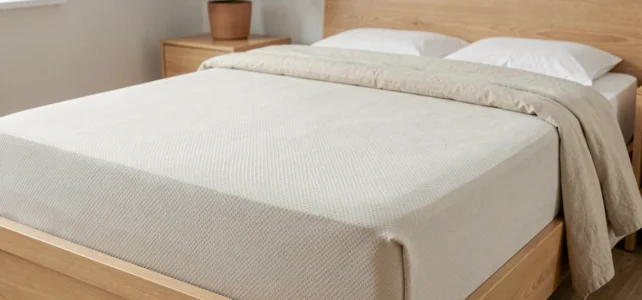
In a geriatric service, nighttime is often when risks increase. A disoriented patient tries to get up, an IV line gets pulled out, a change becomes complicated. It is precisely in these situations that the Sécuridrap Selfia, designed by Mulliez-Flory, makes perfect sense: a textile device that keeps the patient safe in bed without resorting to rigid restraint.
Textile medical restraint device: what the Sécuridrap changes on the ground
We are talking about a medical device, not just an improved sheet. The Sécuridrap Selfia requires a medical prescription, established after evaluating the benefit/risk ratio for each patient. The company Mulliez-Flory, which manufactures it, is certified ISO 9001 and ISO 13485, two standards that govern quality management and medical devices, respectively.
This regulatory framework has a direct consequence: the initial installation requires mandatory training for healthcare staff. You don’t just place a Sécuridrap like you tuck in a bed. Teams learn to check the attachment points, to control the patient’s residual freedom of movement, and to organize regular monitoring.
The product is not designed for continuous use 24 hours a day. Its use remains occasional, supervised, and documented in the patient’s file. To learn more about the Sécuridrap, the ANSM notice details all safety instructions and contraindications.
Access slits for care: the textile detail that changes patient management
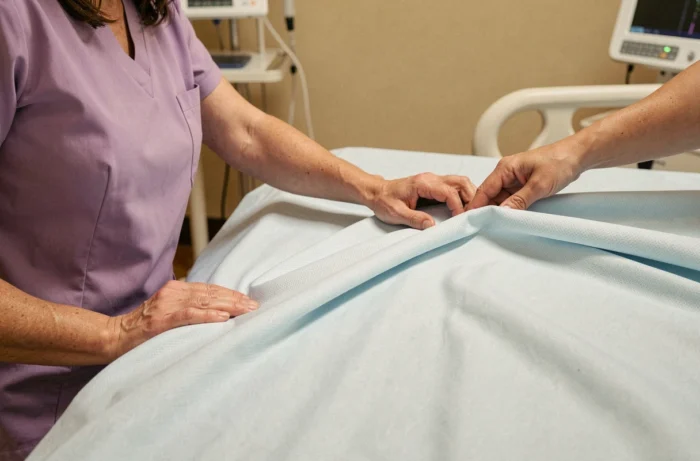
One point that online content almost systematically neglects: the Sécuridrap incorporates side slits designed for the passage of IV lines, tubes, and drains. This is not a gimmick. For a patient on IV or with a urinary catheter, every manipulation of the bed linen poses a risk of accidental disconnection.
With these openings, the caregiver can access the care area directly without moving the patient. Changing incontinence pads can be done without painful movements or complete repositioning. Time is saved, pain is reduced, and technical incidents on medical devices connected to the patient are limited.
Beyond classic geriatrics
The clinical positioning of the Sécuridrap goes beyond simple prevention of nighttime falls in the elderly. It is also indicated for post-operative patients with weight-bearing restrictions, or for disoriented individuals of any age. This versatility makes it a tool used in various departments, from rehabilitation to intensive care.
Patient comfort and textile quality: breathable materials and maintenance
The textile used must meet a dual requirement: sufficient mechanical resistance to ensure safety, and breathable comfort to avoid turning the bed into a sauna. The fabric of the Sécuridrap is designed to withstand repeated industrial washes, a necessary condition in a hospital environment where hygiene protocols are strict.
The quality of the materials plays a direct role in the acceptance of the device by the patient. A rough or non-breathable textile increases nighttime agitation, which goes against the desired objective. A breathable and soft material reduces the risk of rejection by the patient, a factor that healthcare teams observe daily.
- The fabric must withstand industrial laundry cycles without losing its mechanical properties or softness.
- The breathability of the textile limits excessive sweating, a source of discomfort and skin maceration in bedridden patients.
- The seams and finishes are designed to avoid pressure points, especially in patients with fragile skin.
Safety and monitoring: the mandatory rules to know
The ANSM notice for the Sécuridrap is unequivocal: failure to comply with the instructions can lead to a risk of death by strangulation. This mention, far from being trivial, reminds us that any textile restraint remains a medical act in its own right.
In practical terms, several rules must be followed:
- The prescription is documented in writing in the patient’s file, with regular reevaluation of the benefit/risk ratio.
- No repairs to the device can be made by anyone not authorized by Mulliez-Flory.
- Monitoring must be organized at regular intervals, with planned and documented rounds.
- The Sécuridrap is contraindicated for certain patient profiles (feedback on this point varies according to departments and encountered pathologies).
Medical prescription and traceability
The fact that this product requires a medical prescription distinguishes it from bed restraint devices sold without regulation. Each implementation is a tracked, dated, and justified act. This traceability protects both the patient and the healthcare team in case of disputes.
The origin of the project sheds light on this requirement. In 2002, a textile engineer from Mulliez-Flory observed the concrete difficulties faced by healthcare staff in geriatric centers. The development of the Sécuridrap arose from this field immersion, with discussion groups bringing together caregivers and patients. The product was not designed on a corner of a desk, but shaped by the real constraints of daily care.
The Sécuridrap Selfia remains a niche device, reserved for specific clinical situations. Its value lies less in textile innovation than in the rigor of its usage framework: prescription, training, monitoring, traceability. It is this complete protocol, and not the sheet alone, that guarantees the safety of the patient.