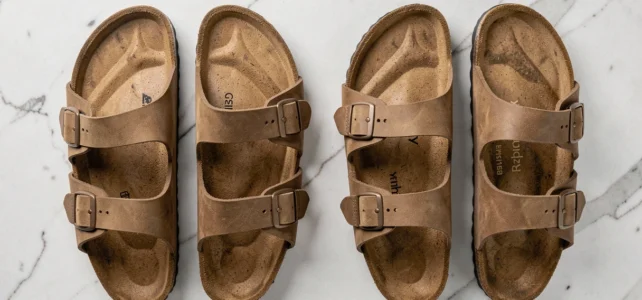
Two sandals placed side by side in a display window, and yet almost everything separates them: the design philosophy, the target audience, the rigidity of the sole. Billowy and Birkenstock come up in the same searches because they occupy a similar niche, that of the open shoe designed for comfort. But comparing them without looking under the sole is to overlook criteria that truly change daily wear.
Soft sole vs. anatomical sole: what the foot really feels
Have you ever noticed that a very flexible shoe doesn’t suit everyone? This is the starting point for understanding the gap between these two brands.
Billowy designs models with thin and flexible soles, close to the so-called “foot-friendly” approach. The principle: allow the foot to move freely, with an almost zero drop. This choice works well for children whose arches are forming normally.
Birkenstock adopts the opposite logic. Its cork and latex sole incorporates marked arch support, a metatarsal support, and a heel cup. The foot is guided, not simply placed on a flat surface. This stiffer structure requires a few days of adjustment, but it keeps the foot in precise alignment.
By exploring the differences between Billowy and Birkenstock, one quickly notices that this choice of sole determines everything else: durability, target audience, and even usage contexts.

Billowy children’s sandals: limits of the barefoot approach
Billowy primarily targets children. Its models emphasize flexibility, bright colors, and lightness. For a normally developing foot, this approach works.
But podiatrists remind us of a nuance rarely mentioned in comparisons. The ICOPCV (Institut Collégial de Podologie de la Comunidad Valenciana) notes in 2025 that barefoot shoes are not suitable for children with pronounced flat feet or walking disorders. In these cases, the lack of support worsens the problem instead of promoting natural development.
Specifically, if your child walks with their feet turned very inward or complains of pain after an active day, a flat and flexible sole may not be the answer. A podiatric opinion before purchase can help avoid poor choices.
When flexibility becomes a selection criterion, not an automatic advantage
The flexibility of a Billowy appeals to parents because it seems “natural.” But natural does not mean suitable for all feet. The right criterion is the child’s morphology, not the brand’s philosophy.
Birkenstock beyond the sandal: orthopedic recognition of closed models
Birkenstock is associated with the Arizona or Madrid sandal. What French-speaking comparisons overlook is that the brand has expanded its range to include closed shoes that change the game.
In 2024, the Birkenstock Bend Low (a low sneaker) appears in a selection of shoes recommended by orthopedic surgeons, published by EatingWell, alongside models from Hoka, New Balance, and Brooks. Birkenstock is recognized in a medical context, not just as a lifestyle brand.
This orthopedic legitimacy concerns closed models, not just sandals. For someone looking for lasting comfort year-round, Birkenstock thus offers continuity between summer sandals and cold-season shoes, with the same cork footbed.
Why this distinction matters for choice
If you compare Billowy and Birkenstock solely on sandals, you only see part of the picture. Birkenstock offers a complete ecosystem (sandals, clogs, sneakers) that relies on the same sole technology. Billowy remains focused on a children’s segment without this depth of range.
Concrete criteria for choosing between Billowy and Birkenstock
Rather than a generic table, here are the questions to ask yourself before buying:
- The age of the wearer: Billowy targets children with models suited for growing feet. Birkenstock covers children, women, and men with extended widths and sizes.
- The morphology of the foot: a foot without particularities can accommodate both brands. A flat foot, a high arch, or a need for support directs toward Birkenstock and its structured sole.
- The desired durability: Birkenstock’s cork reformats over time and molds to the foot. Soft soles like Billowy wear out faster on hard surfaces.
- The budget: Billowy is clearly positioned at a lower price point. Birkenstock costs more, but the longevity of the sole compensates over several seasons.
- Daily usage: for a child who runs, plays, and changes shoes often, Billowy is sufficient. For an adult who walks long distances, the anatomical sole of Birkenstock reduces foot fatigue.
Size and width: a detail that changes real comfort
Birkenstock offers two widths on most of its models: regular and narrow. This option may seem trivial, but it determines whether the foot slides laterally in the sandal or stays well secured.
Billowy generally does not offer this width choice. For a narrow foot, some Billowy sandals may seem too wide, with no possibility for adjustment. In contrast, Birkenstock allows precise tightening or loosening of leather or suede straps with adjustable buckles.
Choosing the right width avoids friction and blisters, especially during the first weeks of wear. If you order online, checking the Birkenstock size guide (which distinguishes between narrow and regular widths) can save you an unnecessary return.
The choice between Billowy and Birkenstock is not just a question of brand or price. It is based on three concrete data: the age of the wearer, the shape of their foot, and the intended usage intensity. A flexible Billowy will suit a child with a standard foot for a summer. A Birkenstock will accompany an adult for several years, with support that the cork sole refines over time.