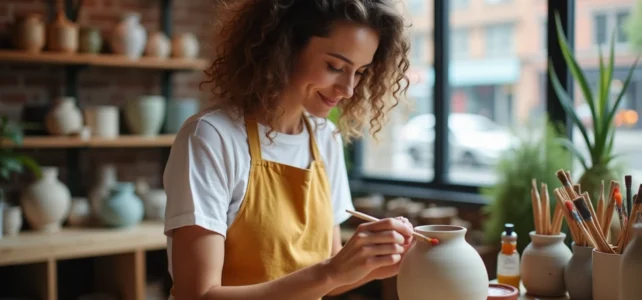
The market for creative hobbies and everyday activities is undergoing a transformation that the usual lists of “50 ideas to do at home” do not capture. Over the past two years, new practices have emerged at the intersection of digital technology, nostalgia, and the need for sensory disconnection.
The leisure trends shaping up for the coming months are no longer limited to macramé or punch needle: they question our relationship with free time, manual crafting, and the technological tools that enter amateur workshops.
Kidulting and sensory hobbies: why adults are returning to tactile activities
The term kidulting refers to this underlying trend that pushes adults towards hobbies reminiscent of childhood games. Slime, sensory kits, immersive puzzles, customizable plush toys: the phenomenon goes beyond mere entertainment.
According to a report from the Revue Républicaine dedicated to creative activities for adults, this search for playful and regressive pleasure is now being acknowledged by online workshop platforms. Some design programs labeled as “anti-burnout,” focused on manipulating clay, soft textures, or pressing objects.
What distinguishes kidulting from a simple return to childhood is its grounding in a logic of well-being. Adults who engage in it are not looking to produce a finished object or acquire a skill: they seek an immediate sensory experience. Feedback from the field varies on the sustainability of this enthusiasm, but its visibility on social media and workshop platforms remains strong.
Several resources compile ideas for creative activities for adults, and the leisure pages of Blognet News reflect this diversification of practices beyond traditional formats.
Accessible digital fabrication: when DIY meets laser cutting and 3D printing
Creative hobbies are no longer limited to paper, thread, and glue. The hybridization of manual work and digital fabrication is reshaping everyday DIY projects. Compact laser cutters, entry-level 3D printers, free modeling software: these tools, once reserved for professional fablabs, are entering home workshops.
Recent analyses of creative hobbies identify this convergence as a structuring trend. An amateur can now design a piece on screen, cut it with a laser from wood or leather, and then assemble it by hand. The result combines digital precision with artisanal finishing.
What this concretely changes for creative projects
The technical barrier remains real. Mastering vector cutting software requires several hours of learning, and the cost of a machine, even entry-level, represents an investment. However, online communities share ready-to-use cutting files, which reduces the learning curve for beginners.
- Laser cutting: allows for working with fine wood, leather, and thick cardboard with precision impossible by hand, for decor or jewelry projects
- 3D printing: ideal for creating unique pieces (handles, supports, resin molds) that complement a craft project
- Free modeling software: several accessible tools allow transitioning from sketch to usable file without professional training
This hybridization blurs the boundary between craftsmanship and manufacturing. It attracts an audience that did not identify with traditional creative hobbies.
Participatory artistic projects and collective workshops: a leisure activity that goes beyond the home
Alongside solitary practices, participatory artistic projects are gaining ground. From collective murals to neighborhood workshops, these initiatives transform creative leisure into a social activity. Specialized sources report a multiplication of these formats in both urban and rural settings.
The principle is simple: a framework is set (theme, technique, materials), and each participant contributes to a common work. Ceramics, mural painting, textile assembly, the supports vary. What remains constant is the collective dimension that distinguishes these workshops from individual tutorials.
The available data does not allow for precise measurement of the phenomenon on a national scale. Feedback from organizers points to a growing demand, particularly among adults seeking to break free from the isolation associated with remote work.
Sustainable creative hobbies: recycling and upcycling as a guiding thread
The idea of making instead of buying is not new. What has changed is the central place of creative recycling in DIY project ideas. Transforming everyday objects (jars, fabric scraps, pallets, old clothes) into decorative or functional pieces is becoming a reflex for a growing number of enthusiasts.
This approach addresses two distinct motivations:
- A genuine environmental concern, driven by a generation questioning the overconsumption of new materials
- A concrete budget constraint, as recycling allows for launching creative projects without investment in supplies
- An aesthetic appeal for the embraced imperfection, applying wabi-sabi to interior decor
Platforms offering tutorials now dedicate entire sections to repurposing common objects. Making from what you already have becomes a selection criterion for projects, even before considering the difficulty level or the final outcome.
Learning upcycling techniques without specialized materials
The most accessible entry point remains paper and cardboard. Free technical sheets circulate online for creating decorative objects, storage solutions, or gifts from recovered materials. Transitioning to more elaborate techniques (plant dyeing on recycled fabric, mosaic from broken dishes) requires gradual learning, but resources are plentiful.
Current leisure trends share a common trait: they place the gesture, sensation, and process at the center of the activity, rather than the result. Whether through kidulting, digital fabrication, collective workshops, or creative recycling, everyday life becomes a playground for experimentation where the boundary between producing and relaxing blurs.