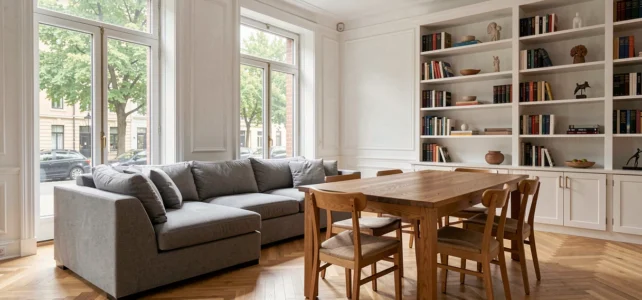
A 5-room apartment is not just four bedrooms and a living room. The classification T5 or F5 refers to a dwelling with five main rooms, but the technical reality behind this designation varies significantly depending on the construction period, the real estate program, and the current standards. We observe major design discrepancies in the market between a T5 from the 1970s and a T5 delivered under RE2020, even with comparable surface areas.
RE2020 and New T5: What the Standard Changes for Large Housing
A T5 delivered in a new program for which the building permit was filed after January 1, 2022, falls under the RE2020 environmental regulation. This standard, which replaces RT2012, imposes strict thresholds on three axes: energy performance, summer comfort, and carbon footprint of building materials.
For a large apartment, the constraints on summer comfort are particularly structuring. Living rooms facing south or west, common in traversing T5s, must meet overheating indicators calculated based on heatwave scenarios. This pushes developers to reconsider glazed surfaces, solar protections, and sometimes natural ventilation.
In practice, a new T5 almost systematically aims for an A energy performance label, meaning a consumption of less than or equal to 70 kWh/m²/year and CO₂ emissions not exceeding 6 kg/m²/year. These thresholds are almost never mentioned in general purchasing guides, even though they directly condition resale value and the level of charges. If you want to learn more about Immonex, the technical definition of T5 is detailed precisely there.
Actual Size of a T5: The Question of Living Space
The average area commonly cited for a T5 is around 95 m², but this figure masks considerable disparities. A Haussmannian T5 in Paris with ceilings over three meters offers a living volume that is incomparable to a T5 in a residence from the 1980s capped at 2.50 m.
The Carrez law, which regulates the mention of private surface area in co-ownership, only takes into account areas where the ceiling height exceeds 1.80 m. This rule sometimes excludes nooks, low mezzanines, or parts under the eaves that are nonetheless included in the plan.
Minimum Room Size and Impact on Credit
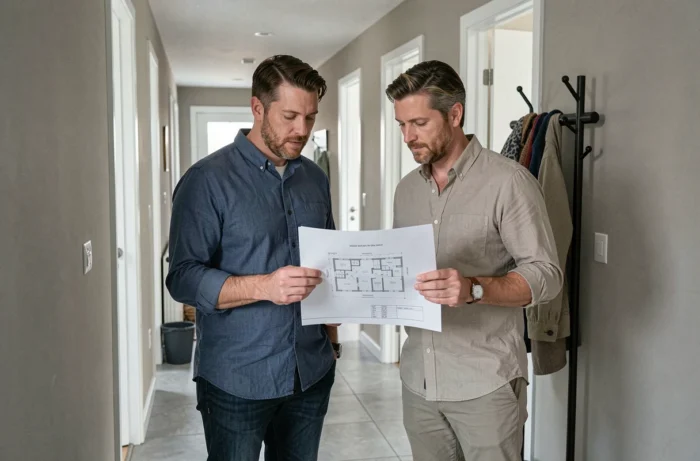
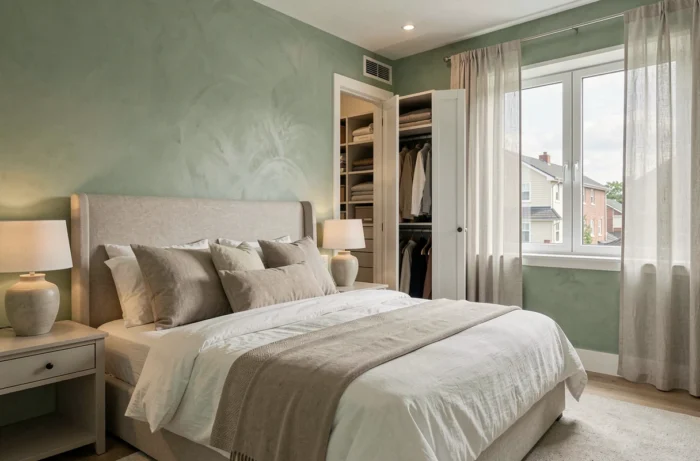
We recommend checking that each bedroom reaches at least 9 m² of floor area and 2.20 m of ceiling height. Below these thresholds, the room may be reclassified as a hallway or office by banks during the loan application process. A T5 with one bedroom measuring 7 m² risks being evaluated as a T4, directly impacting the amount of financing granted.
This constraint is reinforced in new builds, where developers calibrate plans to avoid any ambiguity. In older properties, redistributing spaces (knocking down a partition, creating an additional bedroom) requires checking these minimums before starting work.
Buying an Old T5: Renovation Items to Anticipate
Buying a 5-room apartment in the old market often represents a total budget exceeding the displayed price. Three items concentrate the bulk of renovation expenses:
- Bringing electrical and plumbing systems up to standard, particularly burdensome in buildings constructed before 1975, where networks may not have been updated since construction
- Thermal insulation, which conditions the DPE classification and thus access to the rental market (a property classified G is prohibited from being rented out since 2025, and class F will follow)
- Redistributing dark or windowless rooms, common in T5s resulting from the merging of two apartments, where some bedrooms end up without windows or with insufficient natural light
The renovation budget for an old T5 can represent a significant portion of the acquisition price, especially in tight areas where the price per square meter is already high. We observe that buyers often underestimate this item, complicating the financing plan later on.
Rental Investment in T5: Yield and Tenant Profile
The T5 for rental investment remains a niche segment. Rental demand is mainly focused on T2 and T3, but T5s attract a specific profile: blended families, regulated co-living, and self-employed professionals needing a home office.
In co-living, a T5 can generate a rental yield higher than that of a T3 or T4 thanks to the multiplication of rents per room. The individual lease per tenant, now common, secures income even in the event of a tenant’s departure. The condition: having at least two bathrooms, a criterion we consider non-negotiable for this type of rental.
Co-ownership Charges and Taxation
The current charges of a T5 are proportional to the shares, thus significantly higher than for a small apartment in the same residence. The costs for collective heating, elevators, and maintenance of common areas weigh more heavily on larger units.
From a tax perspective, the actual taxation regime for rental income allows for the deduction of renovation costs, loan interest, and co-ownership charges. For an old T5 requiring heavy renovation, this mechanism can absorb several years of rental income and significantly reduce taxation.
The choice of a T5, whether as a primary residence or as an investment, relies on a precise technical analysis: compliance of areas per room, actual energy performance, condition of networks in older properties, and alignment between the plan and intended use. A well-designed T5 with compliant bedrooms and strong energy performance remains a solid real estate asset, provided that the verification step is not overlooked before signing.