
Interior architecture attracts profiles from graphic design, styling, scenography, or product design. These creative paths share a common foundation (sense of space, visual culture, mastery of color) but often encounter confusion with the profession of DPLG architect. Understanding what separates these two fields of intervention allows for a clearer measurement of the actual space in which a creative profile can operate without an architect’s diploma.
Scope of Intervention: Interior Architect vs. DPLG Architect
The boundary between the two professions is based on precise technical and regulatory criteria, not on a hierarchy of talent. The table below summarizes the concrete differences.
| Criterion | Interior Architect | DPLG Architect |
|---|---|---|
| Non-load-bearing partitions | Can move, create, or remove them | Can move, create, or remove them |
| Load-bearing wall, façade, extension | Cannot intervene alone | Competent, signs the plans |
| Building permit | Does not sign for interior layout | Signs it |
| Threshold of 150 m² (single-family home) | Can design the project below | Mandatory beyond |
| Circulation, lighting, zoning | Main area of action | Also intervenes, often on a larger scale |
This threshold of 150 m² of floor area constitutes a concrete tipping point. Below this, a single-family home project can be designed and submitted without an architect. It is within this regulatory space that creative profiles find a legitimate field of practice.
As soon as a load-bearing wall, façade, or extension enters the project, one must switch to a DPLG architect or a study office. This limit is not a hindrance: it defines a clear perimeter where interior architecture for creative profiles makes perfect sense, focusing on the reorganization of living space.
Transferable Skills from a Creative Background
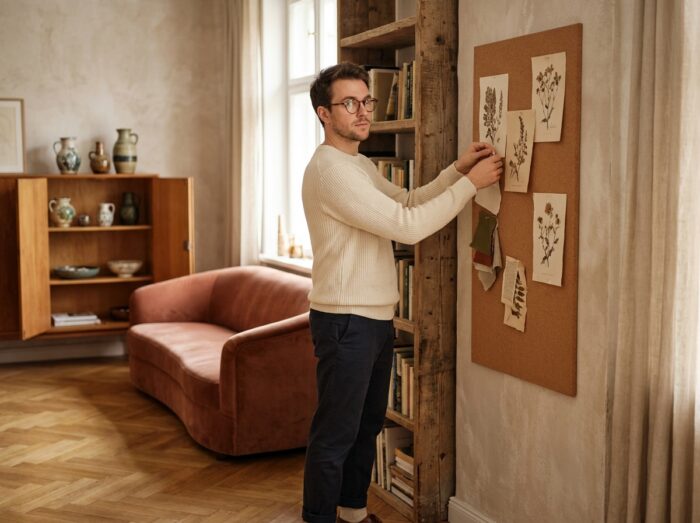
A graphic designer who creates visual identities knows how to prioritize information within a given space. A scenographer thinks in volumes, pathways, and lighting atmospheres. A textile stylist masters the associations of materials and colors. These skills are not peripheral to interior architecture: they form part of its foundation.
The difference with a traditional interior architect’s path lies elsewhere. There are often three blocks of know-how that are lacking:
- The technical reading of a plan (dimensions, accessibility standards, identification of existing networks) which conditions the feasibility of any project
- Site coordination, which involves communicating with craftsmen, managing a schedule, and ensuring the conformity of work to the validated plans
- Knowledge of local regulatory constraints (urban planning rules, co-ownership, fire standards for public spaces)
These gaps do not render the creative profile illegitimate. They outline a targeted learning program, much shorter than a complete architecture curriculum.
Continuing Education or Partial Career Change
Several training centers offer pathways for transitioning into decoration or interior architecture, accessible without prior qualifications in the field. The duration varies from a few months to two years depending on the level of technical depth aimed for.
The challenge for a creative profile is not to start from scratch. It is to acquire the missing technical skills without losing the advantage of their visual culture and sensitivity to materials.
Market Demand: Beyond Decorative Residential
The interior architecture market is not limited to choosing cushions and wall colors for apartments. The demand has expanded towards operational projects that specifically value atypical creative profiles.
The design of offices, collaborative spaces, or creativity rooms mobilizes requirements for modularity, zoning, and appropriate lighting. A former scenographer intuitively understands how a space influences the behavior of its occupants. A product designer knows how to think in terms of use and ergonomics.
These tertiary projects represent an often-underestimated outlet for creatives who still associate interior architecture solely with high-end residential.
Digital Tools and Acceleration by AI
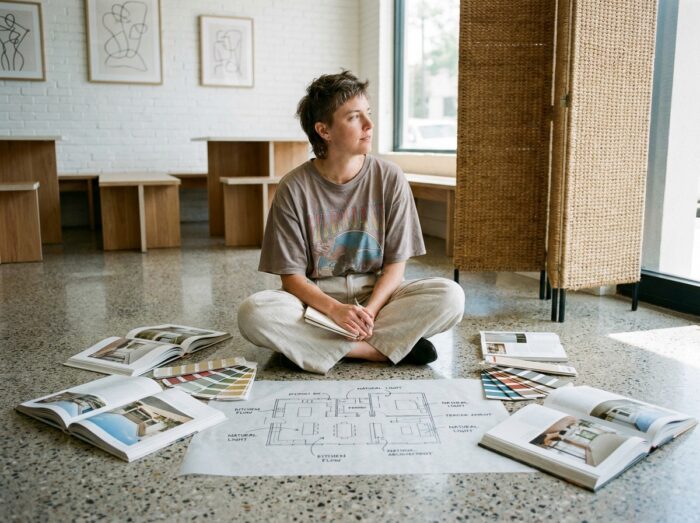
Artificial intelligence tools are now integrated into the design process. They allow for rapid testing of concepts, generating layout variations, and improving client presentations.
For a creative profile already familiar with visual creation software, mastering these tools represents a competitive advantage. AI accelerates the exploratory phase without replacing the human eye on usage constraints and material choices.
Free 3D planning software complements this toolkit by enabling the production of professional renderings without heavy initial investment. The technical barrier to entry is lowered, which strengthens the position of profiles that compensate with a solid aesthetic culture.
Professional Positioning: Interior Architect, Decorator, or Space Designer
The confusion between these titles hinders many creatives. Each covers a different scope.
- The decorator works on furniture, textiles, colors, and accessories without altering the structure of the space
- The interior architect rethinks circulation, moves non-load-bearing partitions, modifies natural and artificial lighting, and coordinates the work
- The space designer (or space planner) sits between the two, with an emphasis on functionality and user experience, often in commercial or event contexts
A creative profile from graphic design or design finds themselves more naturally in space design or interior architecture than in pure decoration. The choice of professional title has a direct impact on the type of clients attracted and on the perception of the added value offered.
The common thread remains the same: transforming a volume into a place that works for its occupants. The title on the business card matters less than the ability to read a plan, communicate with an electrician, and deliver a coherent space between the initial concept and the final result.