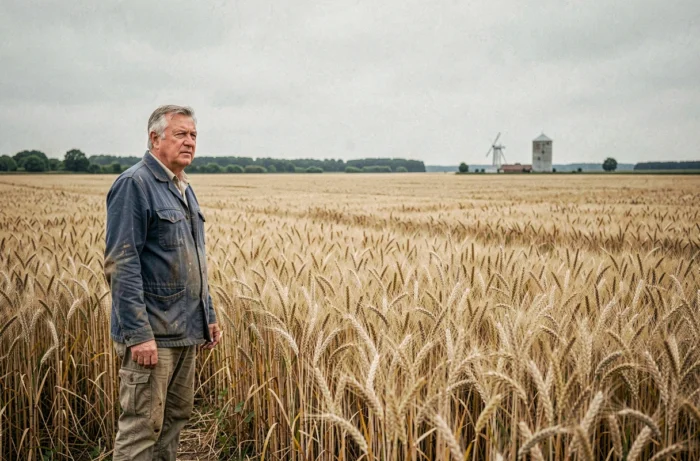
When trying to find out which agricultural operation holds the record for the largest area in France, one encounters a concrete problem: no institutional source publishes an official ranking. The area of the largest agricultural operation in France remains difficult to establish with certainty, because the very notion of operation varies depending on whether we are talking about declared UAA, land owned outright, or land controlled through a network of companies.
Accumulation of agricultural companies: why the largest areas remain invisible
On the ground, no one stumbles upon an operation of several thousand hectares indicated by a sign. The largest structures operate through accumulation of distinct agricultural companies, each declared separately.
The setup often relies on the SCEA (société civile d’exploitation agricole). An operator can gradually buy out the shares of neighboring SCEAs without acquiring land in the strict sense. The total area operated under the same economic control can sometimes reach several thousand hectares, without any centralized registry reflecting this. To better understand this phenomenon, one can look at the area of the largest agricultural operation in France and the profiles behind these figures.
The blind spot of official statistics
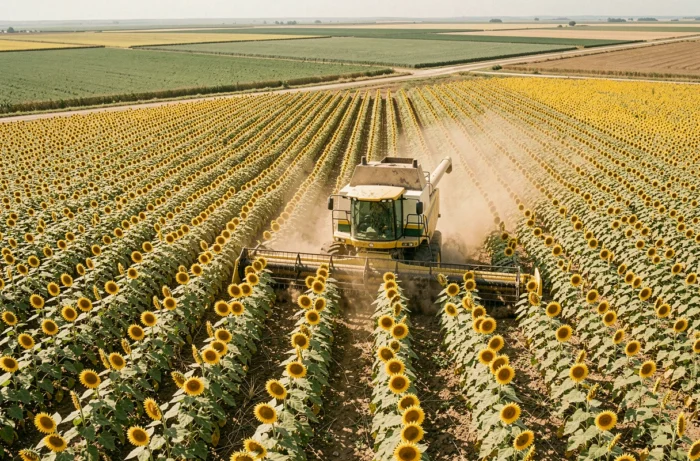
The agricultural census operates by individual operation. When a holding manages ten SCEAs of 300 hectares each, the statistics count ten average operations. The actual concentration disappears.
Online testimonies mention operators working on 4,000 hectares. No independent source allows for verification of these figures.
69 hectares of average UAA: a figure that hides considerable disparities
In 2020, the average UAA per operation in metropolitan France was 69 hectares according to the agricultural census. This figure flattens very different realities.
In Beauce, Picardy, or Champagne, cereal operations regularly exceed several hundred hectares, with parcels spread across several municipalities. Conversely, a few hectares of vineyards or market gardening generate comparable revenue. UAA alone does not provide information on profitability or the economic power of a farm.
- Intensive livestock farming, particularly in the pig sector, accumulates land through corporate structures rather than by expanding a single entity
- Vineyards and market gardening operations remain on small areas, but with a value added per hectare much higher than that of large crops
Depending on the definition used, the answer to the question “what is the largest agricultural operation in France” changes completely.
SCEA, GFA, EARL: setups that complicate the calculation of actual area
Understanding land concentration in France involves legal tools. The SCEA remains the preferred vehicle for large structures, as it allows the entry of non-operating partners and the gradual buyout of shares.
How the SCEA facilitates expansion
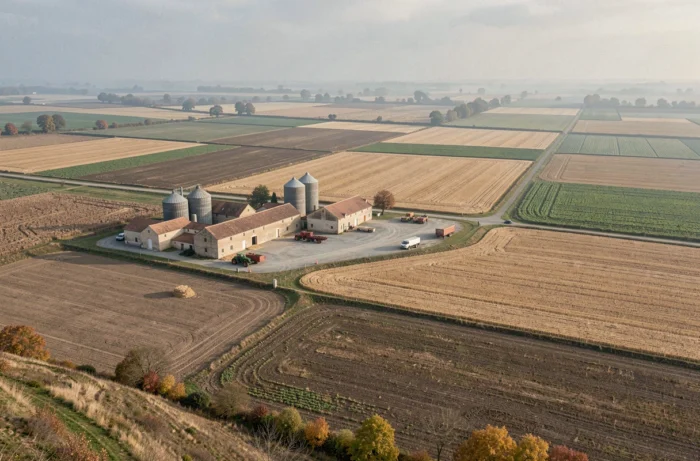
Buying the shares of a neighboring SCEA is not the same as buying a field. It is acquiring social shares of a company. The current legal framework makes this type of transaction less visible to land regulatory bodies, which facilitates gradual accumulation.
The GFA (groupement foncier agricole) and the SCI complement the system by separating ownership and operation. The same group can own the land through a GFA while operating it through an SCEA, making the calculation of the total area even more opaque.
A direct barrier to farm succession
These operations built by stacking companies pose a concrete problem at the time of succession. The capital needed to buy out all the shares far exceeds the capabilities of a young entrant, even with available aids.
We observe increasingly capitalized farms that escape the classic generational renewal. The profile of the successor changes: it is necessary to mobilize investors or enter into the corporate logic from the start.
Record operations in France: what can be asserted and what remains unclear
No French operation is officially designated as the largest in the country. Feedback varies on this point depending on whether one measures the declared UAA under the CAP, the land owned, or the perimeter of a corporate group.
- Some structures control several thousand hectares by accumulating companies
- The pig sector is identified as particularly affected by land accumulation through corporate setups
- The agricultural census does not allow for reconstructing the perimeters of multi-company groups
The record depends on the chosen criterion: UAA of a single legal entity, or cumulative area under the same economic control. As long as statistical tools do not take into account corporate setups, the answer will remain elusive in a registry that was not designed for this reality.