
Carrying your baby against you provides reassuring contact for the child and frees the parent’s hands. However, after several weeks of daily use, some parents experience discomfort, pressure, or significant pain in the chest area. This pain, often mistaken for simple back pain, can be explained by postural, muscular, and equipment adjustment mechanisms.
Weakened trunk muscles in postpartum and carrying: an underestimated link
Most content on carrying focuses on back pain. However, chest pain in carrying parents is common, but it rarely appears during the first uses: it develops gradually as the load increases with the baby’s growth.
An often-overlooked aggravating factor is: the condition of the pelvic floor and abdominal strap after childbirth. When the deep abdominal muscles (transverse, obliques) have not regained their tone, the trunk compensates by engaging the intercostal muscles, the pectoralis major, and the accessory respiratory muscles more. The result: a sensation of pressure or pain in the sternum, ribs, or upper chest during carrying.
Postpartum specialists emphasize that lower back pain or a feeling of heaviness in the lower abdomen during exertion (including carrying your baby) should lead to stopping the activity and consulting a professional trained in pre/post-natal care. To better understand chest pain on Optisanté, one must first accept that the chest does not work in isolation: it depends on the entire muscular chain of the trunk.

Baby carrier adjustment and chest pain: three common mistakes
An improperly adjusted baby carrier redistributes the load unevenly. The baby’s weight, instead of being distributed between the hips and shoulders, concentrates on the upper chest. Overly tight straps compress the rib cage and hinder rib expansion during inhalation.
Three recurring adjustment mistakes are seen in parents who consult for chest pain:
- The front strap or abdominal belt of the baby carrier is positioned too high, at the level of the floating ribs instead of resting on the hips. The pressure then directly affects the diaphragm.
- The straps are crossed too low in the back, pulling the shoulders excessively backward and creating constant tension on the anterior intercostal muscles.
- The back panel of the baby carrier is too loose: the baby sags, their weight shifts forward, and the parent compensates by arching or contracting the chest muscles to maintain balance.
Each of these mistakes, taken individually, causes moderate discomfort. Combined over several hours of daily carrying, they generate pain that can radiate from the sternum to the shoulder blades.
Physiological carrying and prevention of sternum pain
Physiological carrying, where the baby is seated in a squatting position with knees higher than the buttocks, benefits not only the child. This position brings the baby’s center of gravity closer to the carrier’s chest, reducing the lever arm and decreasing the perceived load on the chest.
Osteopaths specializing in carrying recommend checking a simple point: in front carrying, the top of the baby’s head should remain below the parent’s chin. If the baby is positioned higher, the straps pull on the collarbones and compress the upper chest. If the baby is too low, the parent’s back compensates by leaning backward, which contracts the posterior thoracic muscles.
On the other hand, a well-adjusted back carry significantly relieves the chest compared to front carrying, provided that the baby has achieved stable head control. Shifting the weight onto the back frees the anterior rib cage and allows for deeper breathing.
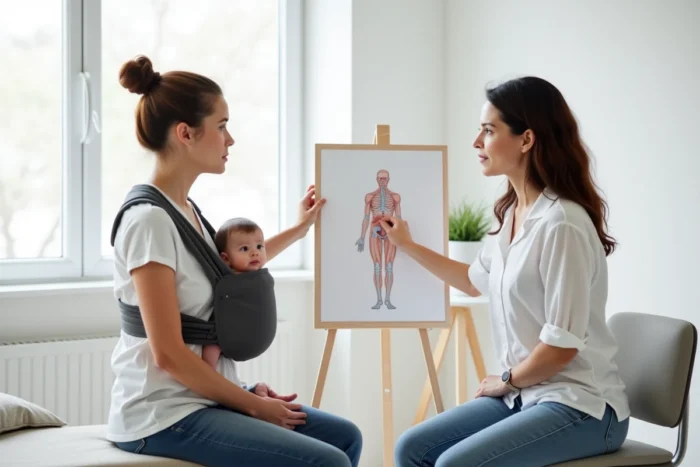
Relieving chest pain related to carrying: concrete actions
Once the pain is established, the first reflex is to check the adjustment of the baby carrier according to the criteria described above. But beyond the equipment, some daily actions help prevent recurrence.
Stretching the pectoral and intercostal muscles after each prolonged carrying session limits progressive stiffness. A simple stretch: place the forearm against a door frame, elbow at shoulder height, then slowly rotate the torso to the opposite side. Hold the position for about twenty seconds on each side.
Strengthening the transverse abdominal muscle also plays a direct role. The more the abdominal strap stabilizes the trunk, the less the thoracic muscles have to compensate. Gentle core stabilization exercises, suitable for postpartum and validated by a physiotherapist, reduce the mechanical load on the rib cage during carrying.
- Alternate between front and back carrying throughout the day to vary load areas
- Limit continuous carrying sessions to reasonable durations and take breaks
- Consult a professional trained in carrying (carrying instructor, osteopath) if the pain persists beyond a few days
A often-overlooked point of caution: chest pain during carrying can mask other causes, including musculoskeletal (costochondritis, Tietze syndrome) or stress-related issues. If the pain persists despite correct adjustment and appropriate exercises, a medical opinion can rule out an origin unrelated to the baby carrier.
Adapting your equipment, monitoring your posture, and strengthening your trunk are sufficient in the vast majority of cases to eliminate chest pain related to carrying or to prevent its occurrence.